Anal Skin Tag Removal at Oshun · Kingston, Jamaica
Anal skin tag removal in Kingston, Jamaica.
An anal skin tag is a small, soft flap of skin beside the back passage. One can be left behind when a pile heals. Tags are usually harmless and do not need to be removed. If one bothers you it can be cut away under a local anaesthetic, but any new lump or bleeding there should be looked at by a doctor first. Removal is estimated at US$500 to US$1,500. You start with a private consultation with Dr. Charles Rockhead, from J$11,000.
No obligation · Every consultation is in-person with Dr. Rockhead.
Anal Skin Tag Removal at a glance
Dr. Rockhead
Your consultation is with him
In person
Consultation before anything is booked
US$500 to US$1,500
Estimated. Quoted in writing first
9 Devon Road
Kingston, Jamaica
No obligation
You decide after the consultation
WhatsApp
Questions answered privately
Every visit, without exception
Four things that are true of every visit
A consultation first
Your first visit is with Dr. Rockhead, in person. An operation is booked only after it.
An examination
The area is looked at before anything is planned.
Your choices explained
He explains your options, including leaving the tag alone.
The plan in writing
You get your plan and your quote before you decide.
Treatment Details
Have any lump or bleeding there looked at first.
Most skin tags are harmless. But you cannot tell a tag from other things yourself. Britain's NHS says to see a doctor for a change around your anus that is not normal for you. For piles, it says to get help urgently for pus, a very high temperature or bleeding with no pain, and to go to a hospital for bleeding that will not stop, a lot of blood or severe pain. Do not cut a tag off at home, because it can bleed a lot. Private question? Message us on WhatsApp.
What is an anal skin tag, and does it need removing?
A skin tag is a soft, skin-coloured growth. Beside the back passage, one can be the extra skin left behind when a blood clot in a pile dissolves. To remove it, the area is numbed and the tag is cut away with a blade or scissors, or burned off with heat.
Does it need removing?
No. The NHS says skin tags do not need to be removed. People choose removal when a tag is irritating, makes cleaning hard, or they do not like how it looks.
Looking after it instead
For piles, the NHS's advice is to keep your bottom clean and dry, drink lots of fluid, eat plenty of fibre, and not push too hard on the toilet.
Could it be something else?
Skin tags can sometimes be confused with warts or moles. A doctor can tell by looking, and may feel inside with a gloved finger. MedlinePlus says a sample is sometimes sent to a laboratory, so ask whether yours would be. A lump or bleeding there can also be a symptom of cancer of the anus. The NHS says having these symptoms does not definitely mean you have it, and that it is important to get them checked.
Will it come back?
The NHS says a removed skin tag does not usually return. New ones may form on other parts of the body. Piles are treated separately, so ask Dr. Rockhead about them.
Before you decide
It is your choice, and it can be sore afterwards.
Removal is a choice, not a need. A tag that does not bother you can be left alone.
After surgery to remove piles themselves, which is a different operation in the same place, MedlinePlus says you may have a lot of pain as the area tightens and relaxes, and that you may need time off work. Ask Dr. Rockhead how sore he expects yours to be, and for how long.
02Medical Leadership
Who do you meet, and what is checked first?
You meet Dr. Charles Rockhead, a gynaecologist, in person, at 9 Devon Road in Kingston. He examines the area and asks about bleeding, pain and your bowels. Dr. Rockhead performs the operation himself.
Tell him about these
Bleeding, a tag that is getting bigger or has become painful, itching or pain, mucus, a change in your bowels, or Crohn's disease or colitis. Each needs its own check before any operation.
Dr. Charles Rockhead, Medical Director — Oshun Cosmetic Services, Kingston.
Dr. Charles Rockhead
Medical Director · Board-Certified OB/GYN · 30+ years of practice
Dr. Charles Rockhead is a board-certified Obstetrician and Gynaecologist with more than thirty years of practice in Kingston. He is the Medical Director of Oshun Cosmetic Services and the founding physician of Amadeo Medical Group, the parent clinical practice.
As MedlinePlus advises before haemorrhoid surgery, tell us every medicine and supplement you take, and tell us if you are or could be pregnant. You may be asked to stop a blood thinner for a time: never stop it on your own. Smoking can slow healing. We ask you to have a light meal that day.
ii.
The anaesthetic
The area is numbed with an injection, so that you stay awake and do not feel the cutting. The injection is briefly uncomfortable.
iii.
The operation
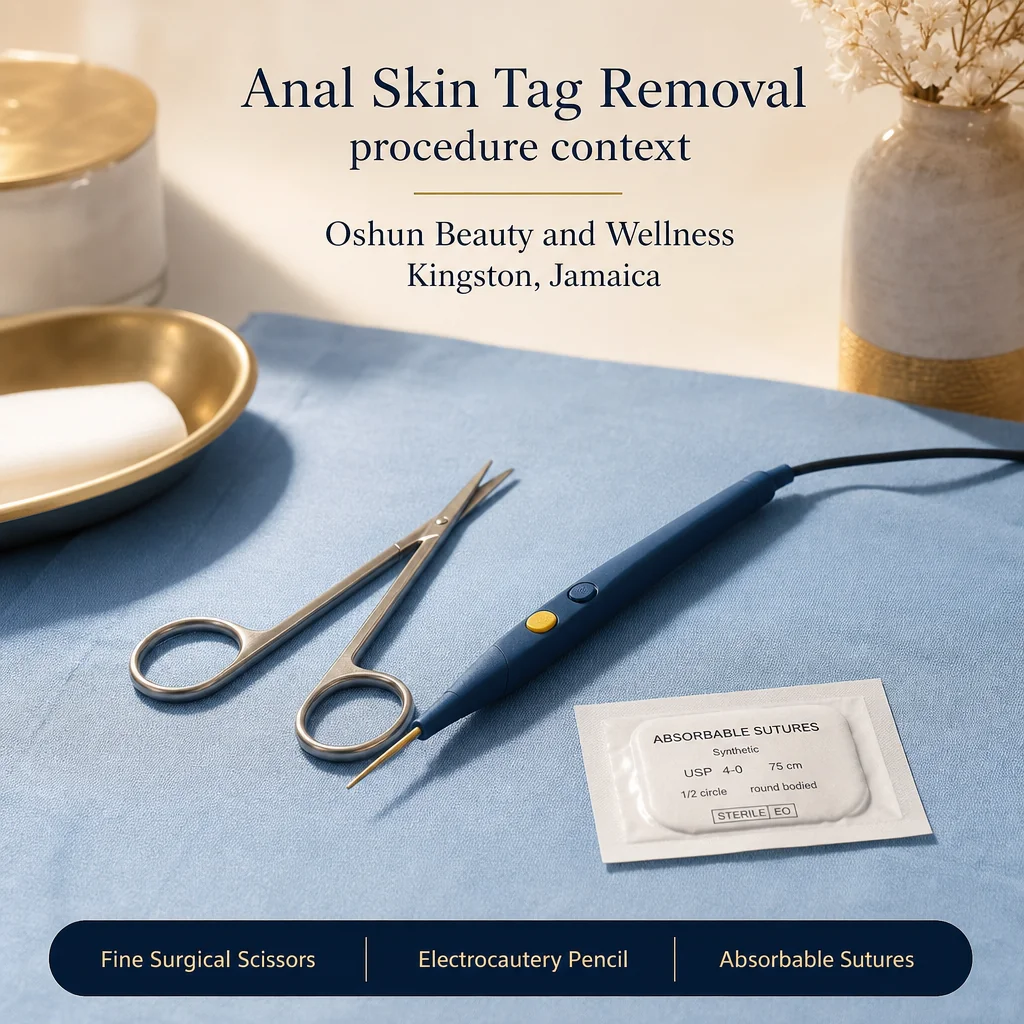
Each tag is cut away with fine scissors or burned off with heat, and bleeding is stopped with pressure or heat. A small wound is left open to heal; a larger one may have a stitch that dissolves.
iv.
Going home
You usually go home the same day. MedlinePlus advises having someone drive you after haemorrhoid surgery, so arrange a driver.
How long it takes
We allow 20 to 40 minutes for the operation and 45 to 60 minutes for the whole visit.
More than one tag
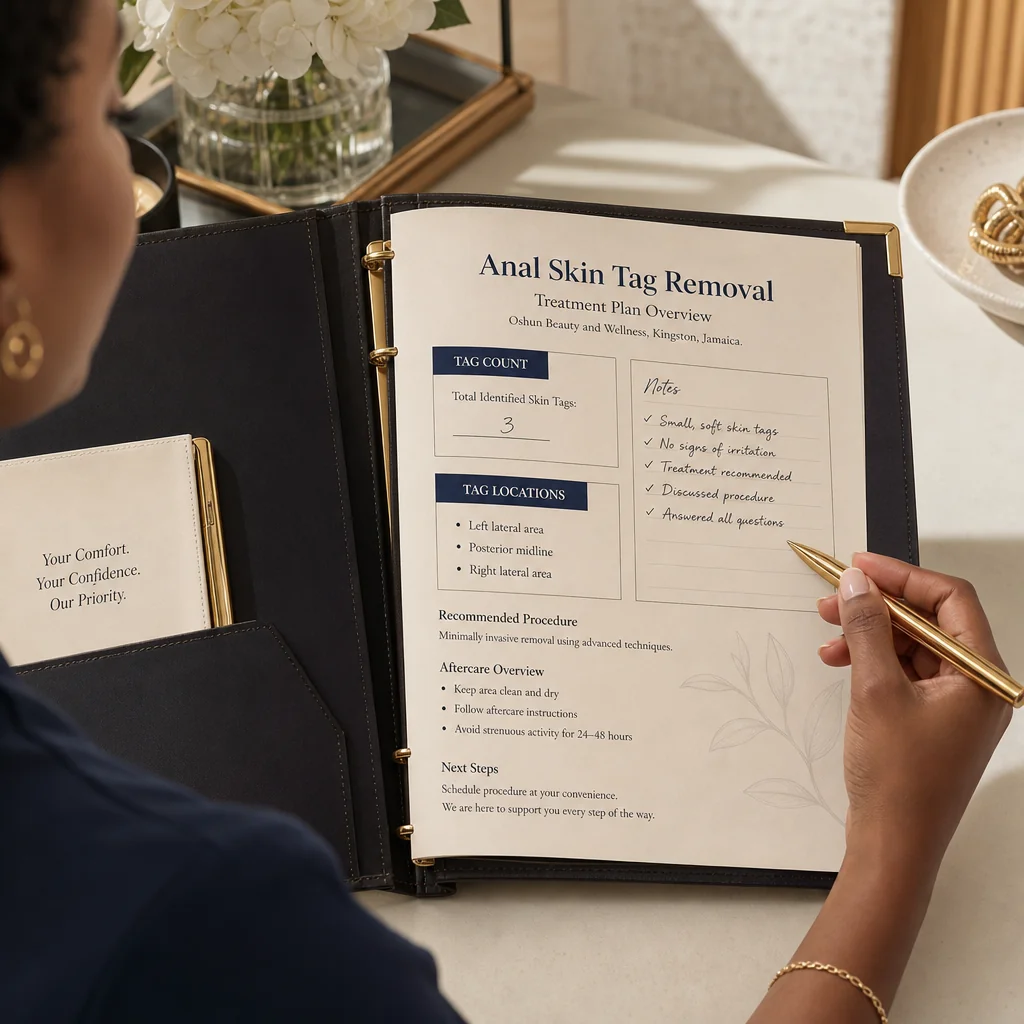
More than one can be removed at a visit. It depends on their size and where they are.
04Recovery
Recovery, and when to get help.
Except where we say "we" or "our", the advice here is MedlinePlus's for haemorrhoid surgery, a different operation in the same place. Ask Dr. Rockhead what applies to you.
After the operation: go to a hospital at once
If you are bleeding and it does not stop, you are bleeding a lot, or the pain is severe.
Call us straight away
On (876) 676-6297, if you have a lot of pain or swelling, a fever, you cannot pass urine several hours after the operation, or you cannot open your bowels because of the pain. We are closed at night and from Friday to Sunday. If we are closed, do not wait for us: go to a hospital.
Pain
Take the pain relief you are given on time. Do not wait until the pain is bad.
Time off work
MedlinePlus says you may need time off. If you sit all day at work, tell Dr. Rockhead and plan for longer.
What is normal
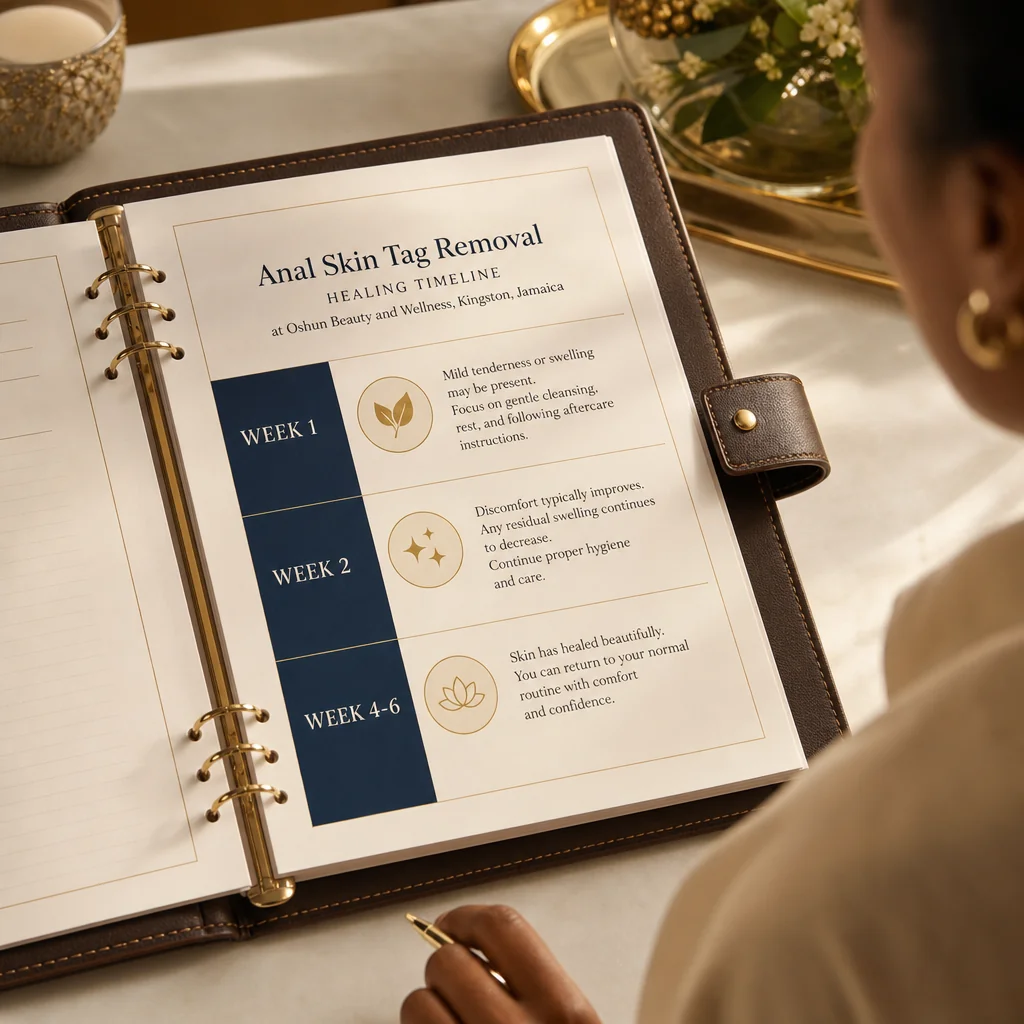
You may notice some bleeding, especially after you first open your bowels. After haemorrhoid surgery, a complete recovery should take a few weeks.
Warm baths
Sit in 3 to 4 inches (7.5 to 10 centimetres) of warm water a few times a day. We also advise one after you open your bowels.
Your bowels
We advise a high-fibre diet. Drink plenty of fluid. Take a stool softener if you are given one, so that you do not strain.
Exercise and sitting
Avoid lifting, pulling and hard exercise until you have healed. We ask you to avoid swimming and long sitting on hard seats for two weeks.
Check-ups
We see you at two weeks and at six weeks.
05Risks
The risks, and who should not have it.
The risks
Any surgery can bleed or get infected, MedlinePlus says. The NHS says removing a skin tag can scar, and a scar can be sore. Healing can be slow. The skin can darken where the tag was, particularly on black or brown skin: that is usually temporary but can sometimes be permanent. After haemorrhoid surgery, MedlinePlus also lists a reaction to the medicines used, constipation, trouble passing urine because of the pain, and leaking a small amount of stool, where it says long-term problems are rare.
Who should not have it
Not with an infection, an abscess or a fistula near the back passage, with Crohn's disease or colitis that is not under control, with a bleeding disorder, or with diabetes that is not under control. In pregnancy it is usually put off.
06Cost & booking
How much does anal skin tag removal cost in Jamaica?
What it costs
The consultation with Dr. Rockhead is from J$11,000. Removal is estimated at US$500 to US$1,500, depending on how many tags there are.
When we are open
Monday and Wednesday, 10 AM to 6 PM. Tuesday and Thursday, 10 AM to 4 PM. Closed Friday to Sunday.
Paying
Cash, debit card, credit card or approved financing. Health insurance does not cover removal done for looks alone. Removal for a medical reason, such as skin that keeps getting sore, may be partly covered, so ask your insurer.
If this sounds right
The next step is a conversation, not a commitment.
Start with a consultation, in person, with Dr. Rockhead.