01The basics
What is removed, and what else could work?
Besides the womb, what is removed depends on the kind, and you have a say in it.
- The kinds
- Total: the womb and the cervix, the neck of the womb. Subtotal: the womb only; the cervix stays, so does its cancer risk, and Pap smears continue. After a total they may too, if it was for cancer or abnormal cells. With either, the tubes and ovaries can be taken or left. A radical hysterectomy takes more, and is usually for cancer.
- Your ovaries
- Removing both brings the menopause at once, at any age. Even if you keep them, it may still come some years early. British advice: remove them only for a serious risk, such as ovarian cancer, though it may be suggested near the menopause. Say before surgery what you want.
- What else could work
- For heavy periods, British guidance (NICE) tries other treatments before an operation, unless you decline them or your symptoms are severe. Fibroids can be treated by blocking their blood supply or by removing the fibroids alone, and they tend to shrink after the menopause. Already tried them? Tell us which.
The short version
What to know first.
It is a major operation with a long recovery, and it cannot be reversed.
Endometriosis can return, and a prolapse can still happen in later years. Many women feel tearful or a sense of loss afterwards; tell us if a low mood does not lift.
02Medical Leadership
Who do you meet first?
Dr. Charles Rockhead, in person, at 9 Devon Road in Kingston. He goes through your history, examines you if needed and explains your options, including not having surgery. Bring any scan report or doctor's letter you have. Dr. Rockhead performs the operation himself; ask us at which hospital.

Dr. Charles Rockhead, Medical Director — Oshun Cosmetic Services, Kingston.
Dr. Charles Rockhead
Medical Director · Board-Certified OB/GYN · 30+ years of practice
Dr. Charles Rockhead is a board-certified Obstetrician and Gynaecologist with more than thirty years of practice in Kingston. He is the Medical Director of Oshun Cosmetic Services and the founding physician of Amadeo Medical Group, the parent clinical practice.
Read the clinic story · View Dr. Rockhead's LinkedIn
03The surgery
How is a hysterectomy done, and how long is the stay?
i.
Getting ready
Stop smoking at least four weeks before, ideally ten, and after. Tell us every medicine, herb and supplement. If you take a blood thinner, you may need to stop it a week or more before, but never stop a medicine without asking your doctor. You have blood tests and a health check beforehand. Arrange a lift home, and an adult to stay with you for the first few days.
ii.
The three routes
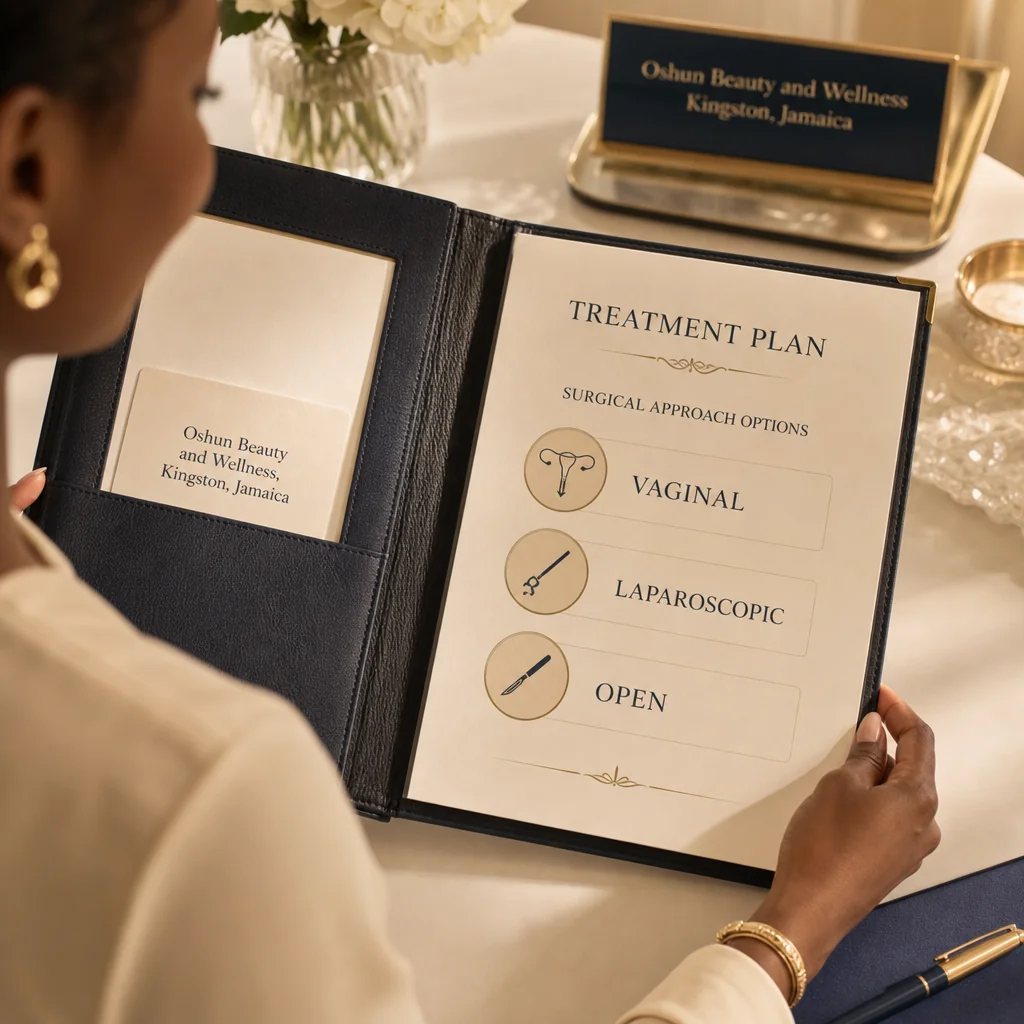
Vaginal: through a cut at the top of the vagina, so the scar is hidden. Keyhole: through small cuts, with a camera. Open: through one cut low on the belly. Which one depends on your history, the reason and your wishes; a womb enlarged by fibroids may mean open surgery. Vaginal or keyhole usually means a shorter stay and a quicker recovery than open.
iii.
The anaesthetic
Usually a general anaesthetic, so you are asleep. For some, a spinal anaesthetic that numbs the lower body is used.
iv.
The stay
Britain's NHS gives one to four days after vaginal or keyhole surgery, and usually up to five after open surgery. Ask how many nights your quote covers.
- Where it is done
- At a hospital or an accredited surgical centre with overnight beds.
04Recovery & aftercare
Recovery: time off, what is normal, and when to call.
- Time off work
- After vaginal or keyhole surgery, many women need four to six weeks; some are back in two to three. After open surgery, many need six to eight. Heavy work may need longer.
- Driving, lifting and sex
- No heavy lifting or sex for at least six weeks; after some operations, at least eight to twelve weeks before sex. No driving for two to six weeks. Keep moving, and avoid long journeys at first, because of clots. Ask for your own limits in writing.
- What is normal
- Expect some pain. Bleeding or discharge, lighter than a period, for up to six weeks; use pads, not tampons. Constipation can happen.
- If your ovaries were removed
- The menopause starts at once. Hormone treatment should be offered, unless there is a reason you cannot take it. Losing the ovaries early can also raise the risk of weak bones and heart disease.
- When to get help
- Call us straight away on (876) 676-6297 if bleeding turns heavy or smelly, a wound is red, hot or oozing, you have a fever, worsening belly pain or vomiting, it burns to pass urine, you cannot pass urine, wind or stool, or one leg is painful, red or swollen. For breathlessness, chest pain or coughing blood, go to a hospital at once. If we are closed or you cannot reach us, go to a hospital.
05Risks
What are the risks, and what should you ask yourself first?
- The risks
- The risk of a complication is small, but this is a major operation. Fibroids raise the risk of serious complications; ask about yours. The main risks: heavy bleeding, which may need a blood transfusion; infection of the wound or the urine; a blood clot in the leg or lung; damage to the bladder, the bowel or the tubes from the kidneys, which is rare; and serious problems from the anaesthetic, which are very rare but can cause death.
- Later on
- An early menopause, even with your ovaries kept. After vaginal surgery, a prolapse, the top of the vagina dropping down, in later years. For some, pain during sex or less interest in it; many women report a better sex life.
- Before you agree
- Not if you may want a pregnancy: ask what keeps the womb. Then ask yourself four questions. Are your symptoms seriously affecting your life? Have you tried the other treatments? Are you ready for a possible early menopause? Do you still want children?
- Who should wait
- Tell us if you are ill beforehand, with a cold, flu, a fever or a herpes outbreak: surgery may be postponed. We do not operate during pregnancy, with an active infection, with a bleeding disorder that cannot be controlled, or where the heart or lungs could not take an anaesthetic.
06Cost & booking
How much does a hysterectomy cost in Jamaica?
- What it costs
- We estimate a hysterectomy at US$8,000 to US$15,000, whichever route is used. Your own figure comes in writing. Ask us whether it includes the hospital, the anaesthetic and the nights you stay.
- The consultation
- Consultations start at J$11,000.
- Paying
- Cash, debit card, credit card or approved financing. Before any operation, ask your health insurer whether your plan pays. We give you receipts to submit.
If this sounds right
The next step is a conversation, not a commitment.
Start with a consultation. We talk through the other treatments first, and no surgery is booked until you say so.
No obligation · Every consultation is in-person with Dr. Rockhead.