Lichen Sclerosus Treatment at Oshun · Kingston, Jamaica

Lichen sclerosus treatment
in Kingston, Jamaica.

Lichen sclerosus is a long-term skin condition that causes itchy white patches, most often on the vulva, the skin around the opening of the vagina. It is not catching, and it is not caused by poor hygiene. A strong steroid ointment, which needs a prescription, usually controls the symptoms, with check-ups over the long term. You start with a consultation with Dr. Charles Rockhead, from J$11,000.

No obligation · Every consultation is in-person with Dr. Rockhead.

Lichen Sclerosus Treatment at a glance

Dr. Rockhead

Your consultation is with him

In person

Consultation before anything is booked

From J$11,000

The consultation

Kingston

Consultations at 9 Devon Road

No obligation

You decide after the consultation

WhatsApp

Questions answered privately

Every visit, without exception

Four things that are true of every visit


A consultation first

You meet Dr. Rockhead in person, and he examines the skin.


Every choice explained

He goes through your choices with you in plain words.


A written plan

You leave with the plan on paper: the treatment, and when to come back.


Seen again

This is long-term care. We check the skin again at set times.

Treatment Details

If the itch keeps coming back.

An itch that will not go, or sore, pale skin that tears easily, is worth having looked at. It is nothing to be embarrassed about, and it can usually be well controlled. Questions first? Message us on WhatsApp.

Medical Director: Dr. Charles Rockhead · Last updated: · Sources: the NHS, the British Association of Dermatologists, the Royal College of Obstetricians and Gynaecologists, Cancer Research UK, DermNet, the Cleveland Clinic and the International Continence Society. Prices: Oshun's own price list.

01The basics

What is lichen sclerosus?

It is a skin condition. It is not an infection, and it is not cancer, though it carries a small risk of skin cancer later, which is why check-ups matter. It causes itchy white patches, most often on the vulva and the skin round the anus. The skin can become sore, and where it has tightened it can tear more easily.

Photograph
Who gets it
Women far more often than men, and most often after the menopause, though it can start at any age and in any skin colour. A child with these symptoms should be seen by a specialist.
Is it catching?
No. It cannot be passed on, sex included. The cause is not known; it may be the immune system.
Can it be controlled?
It can usually be well controlled. Symptoms often come back, so long-term treatment may be needed. The skin can sometimes scar and tighten over time, and scarring does not go away.
How it is diagnosed
Usually by a doctor looking at the skin. It can look like other conditions, which is why it needs to be seen. If there is any doubt, or an area is thickened or will not heal, a small sample of skin (a biopsy) may be needed. It is taken under a numbing injection and may need stitches.

Keep in mind

Keep going when you feel better.

Keep to the plan you are given, and keep your check-ups, even when the itch has gone. Symptoms often come back.

Most women improve with the steroid ointment. If you need more than the ointment, you should be referred to a specialist clinic. Family doctors, dermatologists and specialist vulval clinics all treat this condition.

02Your consultation

Who do you meet?

Dr. Charles Rockhead, a gynaecologist, in person, at 9 Devon Road in Kingston. He goes through your history, examines the skin and explains your choices.

Bring any creams or ointments you use, and any earlier biopsy report.

Dr. Charles Rockhead, board-certified Obstetrician and Gynaecologist, Medical Director of Oshun Cosmetic Services in Kingston, Jamaica

Dr. Charles Rockhead, Medical Director — Oshun Cosmetic Services, Kingston.

Dr. Charles Rockhead

Medical Director · Board-Certified OB/GYN · 30+ years of practice

Dr. Charles Rockhead is a board-certified Obstetrician and Gynaecologist with more than thirty years of practice in Kingston. He is the Medical Director of Oshun Cosmetic Services and the founding physician of Amadeo Medical Group, the parent clinical practice.

Read the clinic story · View Dr. Rockhead's LinkedIn

03Treatment

How is it treated?

i.

The first treatment

A strong steroid ointment, which needs a prescription. It usually helps, and weaker steroids do not control it. Do not borrow one or start one yourself: use yours the way your own doctor tells you.

ii.

How long

The British Association of Dermatologists advises three months for women: once a day for the first month, every second day for the second, twice a week for the third. After that your doctor advises. Some women carry on once or twice a week, or move to a weaker ointment or a moisturiser.

iii.

Using it

A thin smear is enough. If you use a moisturiser as well, leave at least 30 minutes between the two. The leaflet in the packet may warn against use on the genitals; the Association says the ointment it recommends is safe for this condition. It can sting, burn or itch where it goes on: tell us if it does. Used too much, it can thin the skin, which is why the amount and the schedule matter.

iv.

How it settles

Itching often eases within days, and the skin takes weeks to months. If you are no better after two to four weeks, or you get worse, see us. Do not stop suddenly on your own.

Photograph
Laser and PRP
Laser, and PRP (injections made from your own blood), are sometimes offered for lichen sclerosus, and a PRP or laser series is on our own price list. Two international specialist societies said in 2019 that laser should not be used to treat it, because laser treatment of vulval disease is known to cause long-term pain. The steroid ointment remains the first treatment.
04Self-care

Looking after the skin.

Photograph
Washing
Wash once a day with a plain moisturising cream or wash (an emollient) in place of soap. Use your hand, not a flannel, and pat dry. Dab dry after you pass urine. A barrier ointment such as petroleum jelly protects the skin.
What to avoid
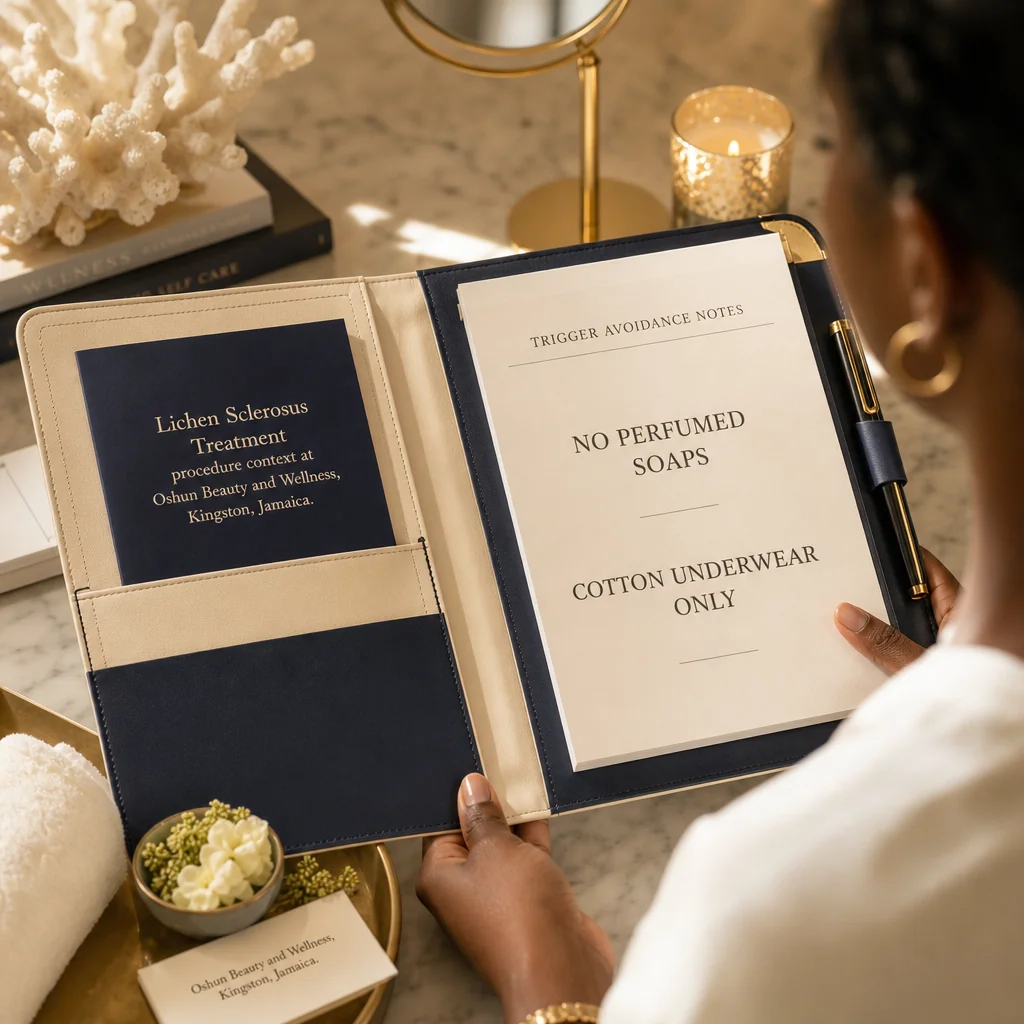
Avoid scented soap, bubble bath and shower gel. Avoid wet wipes, panty liners, fabric conditioner, antiseptics, douches and deodorants. Wash underwear in water, not detergent. Wear loose cotton or silk underwear, and none at night. Avoid tight clothes, and cycling or horse riding until your symptoms improve. Try not to scratch, and do not smoke.
Two cautions
Clothing, bedding and dressings with emollient or the steroid ointment on them catch fire more easily, even when dry. Keep away from flames and lit cigarettes. Oil-based emollients can damage latex condoms and diaphragms.
Sex
If the opening has tightened, sex can hurt and the skin can tear. A lubricant may help, and dilators if needed. If that is not enough, a specialist can advise on a small operation to widen the opening.
Pregnant or breastfeeding
Tell us. A doctor decides whether and how the ointment is used. Tell us too if an illness or a medicine has weakened your immune system.
Check-ups
We see you again at three months, and then every six to twelve months, for life.
05Cancer risk

The cancer risk, and when to see a doctor.

Photograph
The risk
Lichen sclerosus is not cancer. A small number of women with it, an estimated 5 in 100 at most, later get a skin cancer in the affected skin. Treatment that keeps the condition under control lowers that risk. Smoking raises it.
Check yourself
Check the whole area regularly, for life, with a mirror, from the front to the back passage. Look and feel for anything new: a lump, a sore that does not heal, a thickened or crusted patch, a change in colour, a mole that changes. On brown or black skin, colour changes may be harder to see.
See a doctor soon
See a doctor for any new lump. See one too for thickening, soreness or an ulcer (an open sore) that has lasted more than two weeks, whether or not you are using the ointment. Bleeding that is not a period, a lump or swelling in the groin, and pain when you pass urine, open your bowels or have sex are also reasons to be seen.
Go to a hospital
If you cannot pass urine at all. That is very rare.
06Cost & booking

What does lichen sclerosus care cost in Jamaica?

Photograph
What it costs
The consultation is from J$11,000. A biopsy, if one is needed, and follow-up visits are priced separately, and you get the costs in writing.
Insurance
This is a medical condition, so your insurer may reimburse part of the cost. Ask them before you come.
When we are open
Monday and Wednesday, 10 AM to 6 PM. Tuesday and Thursday, 10 AM to 4 PM. Closed Friday to Sunday.
Paying
Cash, debit card, credit card or approved financing.

If this sounds right

The next step is a conversation, not a commitment.

Start with a consultation. Nothing is booked until you decide.

No obligation · Every consultation is in-person with Dr. Rockhead.

The honest answers

Three quick answers.

Tap any to open it.

Is lichen sclerosus contagious?
No. It is not an infection, and it cannot be passed to a partner.
Is lichen sclerosus cancer?
No. It is a skin condition. An estimated 5 women in 100 at most who have it later get a skin cancer in the affected skin, so regular self-checks matter for life.
How do I book a consultation at Oshun?
WhatsApp (876) 676-6297 or schedule a consultation at 9 Devon Road in Kingston.
Often considered alongside

Three treatments patients ask about in the same conversation.

Two paths from here

One conversation away.

An itch that keeps coming back deserves a name and a plan. The consultation is the place to start.

No obligation · Every consultation is in-person with Dr. Rockhead.

Call WhatsApp
Powered by IrieVybz AI — see how this site runs on Karen