01The basics
What is minimally invasive surgery?
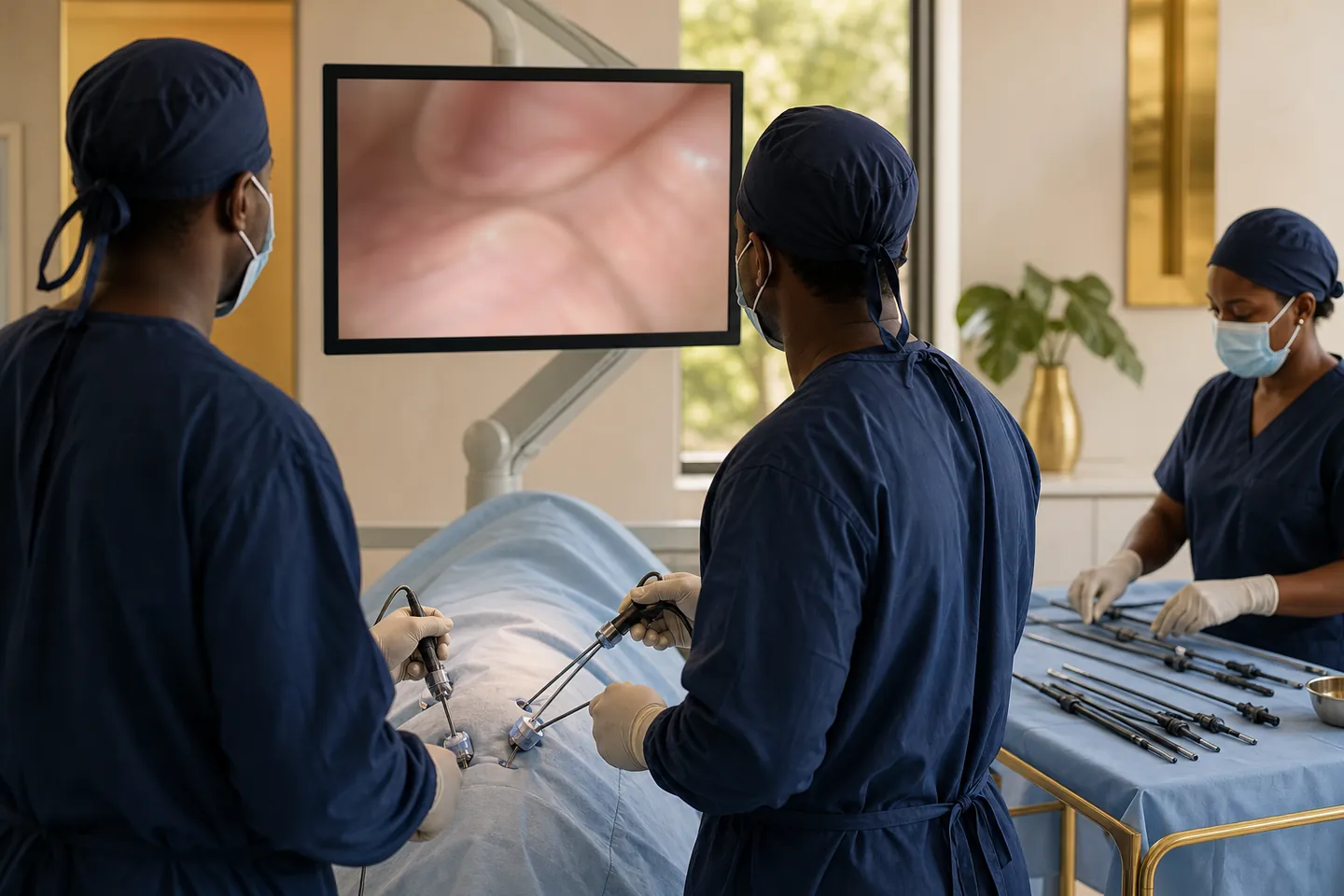
It means operating without one large cut in the belly. There are three ways.
- Keyhole (laparoscopy)
- Small cuts in the belly, usually half a centimetre to one centimetre each. Gas is pumped in to make room, and a thin camera and fine instruments go in. It is used to remove the womb, fibroids, an ovarian cyst or a tube, and to treat endometriosis and scar tissue.
- Through the cervix (hysteroscopy)
- A thin telescope passes through the vagina and the neck of the womb, with no cut. It reaches only the inside of the womb, where polyps and fibroids that grow there can be removed.
- Through the vagina
- The womb can be removed through a cut at the top of the vagina. Repairs for prolapse (when the womb or vagina drops down) are usually done this way too. There is usually no cut on the belly.
- Big fibroids?
- Some can still come out by keyhole, and for some an open cut is advised. A womb much enlarged by fibroids is one reason open surgery may be advised. Fibroid removal keeps your womb; a hysterectomy removes it. Bring your ultrasound report. More on our fibroid removal page.
Keep in mind
What to know first.
Keyhole surgery is still an operation, usually under a general anaesthetic. Healing inside takes weeks, whatever the size of the scar.
Sometimes it has to become an open operation part-way through. At one large NHS hospital, about 1 keyhole hysterectomy in 30 is finished through an open cut. Before the day, agree with your surgeon what should happen if yours is.
New fibroids can form over time, and endometriosis and prolapse can return. Dr. Rockhead talks you through what that means for you before anything is booked.
02Who decides
Who decides which way is right for you?
You and Dr. Charles Rockhead, at a consultation at 9 Devon Road in Kingston. He goes through your history, examines you and explains your options. Not operating is one of them: many problems can be watched, or treated in other ways. He performs the operation himself. Ask where it takes place. Nothing is booked until you decide.

Dr. Charles Rockhead, Medical Director — Oshun Cosmetic Services, Kingston.
Dr. Charles Rockhead
Medical Director · Board-Certified OB/GYN · 30+ years of practice
Dr. Charles Rockhead is a board-certified Obstetrician and Gynaecologist with more than thirty years of practice in Kingston. He is the Medical Director of Oshun Cosmetic Services and the founding physician of Amadeo Medical Group, the parent clinical practice.
Read the clinic story · View Dr. Rockhead's LinkedIn
03The operation
Before and after the operation.
A hysteroscopy usually takes 10 to 15 minutes, longer if something is removed. A keyhole look takes 30 to 60 minutes, and keyhole surgery longer.
i.
Before
You have a check before the operation. Tell us every medicine, herb and bush tea you take, and never stop one unless we ask you to. If you smoke, stop at least four weeks before. We tell you when to stop eating and drinking; follow it exactly.
ii.
The anaesthetic
Keyhole surgery is usually done asleep, under a general anaesthetic. Surgery through the vagina can also be done with an injection in the back that numbs you from the waist down. A hysteroscopy is often done awake: it can hurt, and you can ask for it to stop.
iii.
Going home
After keyhole surgery most people go home the same day or the next. After a keyhole hysterectomy it can be one to three days. Arrange for an adult to take you home and stay with you for 24 hours.
iv.
The first days
Pain in the shoulder is common after keyhole surgery. It comes from the gas and usually lasts a few days.
04Recovery
Recovery, and when to get help.
- Time off work
- One to three weeks if the surgeon only looks, and two to three if something is treated. After a keyhole or vaginal hysterectomy, some need two to three weeks and many need four to six. After an open hysterectomy, some need three to four weeks and many need six to eight. After a cyst is removed, getting back to normal may take as long as 12 weeks.
- Driving, lifting and sex
- Do not drive for 48 hours after a keyhole look, or until you could do an emergency stop; after a keyhole or vaginal hysterectomy that is usually two to four weeks, and after an open one three to six. After a hysterectomy, no heavy lifting for three to four weeks, and no sex for at least six, and only once your surgeon agrees. One US government source says twelve. After other operations we ask you to avoid heavy lifting and sex for two to six weeks, depending on the operation.
- Check-ups
- We check your cuts at one to two weeks and review your healing at six.
- When to get help
- Go to a hospital at once for chest pain, shortness of breath, a very fast heartbeat, coughing up blood, or belly pain that is getting worse with a fever or vomiting. Tell them which operation you had, and when. Call us straight away on (876) 676-6297 for a fever or shivering, vomiting that will not stop, belly pain or bloating that is getting worse, heavy or smelly bleeding or discharge, burning when you pass urine, a cut that is swollen, more painful, bleeding or leaking pus, or pain and swelling in one leg. If we are closed or you cannot reach us, go to a hospital.
05Risks
The risks, and who it may not suit.
- Who it may not suit
- A womb much enlarged by fibroids, a cyst that is very large, a growth that might be cancer, or scar tissue from earlier surgery can mean open surgery is advised. We do not do keyhole surgery with a severe heart or lung condition, and we do not operate in any of these ways with a bleeding disorder. Tell us if you could be pregnant: a hysteroscopy is not done in pregnancy.
- Keyhole surgery and hysterectomy
- Bleeding, infection and a reaction to the anaesthetic. Rarely: damage to the bladder, the bowel, a blood vessel or a ureter (the tube from a kidney to the bladder), a blood clot in the leg or lung, or a hernia at a cut. Keyhole is not safer in every way: at one large NHS hospital, injury to the bladder or a ureter happens in about 1 keyhole hysterectomy in 100, more than with a traditional hysterectomy.
- Getting a fibroid out through a small cut
- It may be cut into pieces first. Sometimes a growth that looks like a fibroid is a hidden cancer. Estimates run from fewer than 1 in 1,000 women having fibroid surgery to about 1 in 225, and it is commoner after 60. A machine that cuts the growth up inside the belly can spread it. The US regulator says to use that machine only inside a bag that holds the pieces, and not after the menopause or over 50. Ask how yours would come out.
06Cost & booking
How much does keyhole gynaecological surgery cost in Jamaica?
- What it costs
- We estimate US$4,000 to US$10,000 for a laparoscopy or a hysteroscopy, and US$8,000 to US$15,000 for a hysterectomy or fibroid removal. Before you agree, make sure your quote shows the hospital and the anaesthetic.
- The consultation
- From J$11,000, in person, with Dr. Rockhead.
- When we are open
- Monday and Wednesday, 10 AM to 6 PM. Tuesday and Thursday, 10 AM to 4 PM. Closed Friday to Sunday.
- Paying
- Cash, debit card, credit card or approved financing. Whether insurance pays depends on your plan, so check before you book.
If this sounds right
The next step is a conversation, not a commitment.
Start with a consultation. Bring any scan reports you have.
No obligation · Every consultation is in-person with Dr. Rockhead.